
Description
The environment
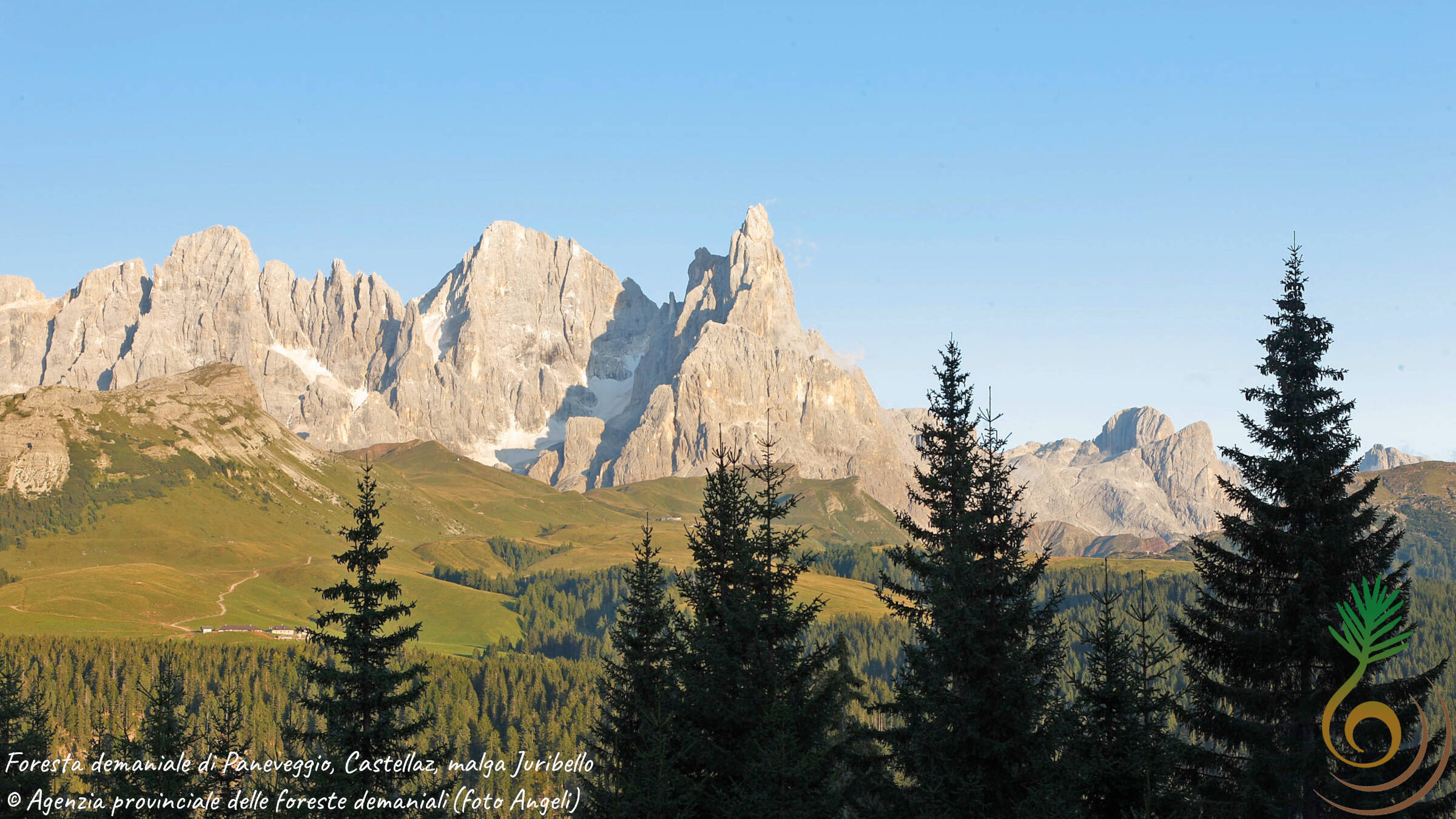
The Paneveggio forest covers the upper part of the Travignolo valley, formed by the porphyries of the Lagorai chain and the Bocche and Juribrutto peaks and closed to the east by the dolomites of the Pale di San Martino. The forest extends from the lower altitude of 1450 m a.s.l. to the limit of the forest vegetation. The rather high average altitude means that the vegetation period is short: consequently, the number of forest species is also limited: spruce, which finds optimum conditions, mixes with larch and stone pine only at higher altitudes, while broadleaf trees are present almost exclusively as subordinate species in the juvenile stages. The growth rate of the plants is also reduced, with the production of rather restricted annual woody rings.
Paneveggio has a long tradition of high-level management and is famous throughout Europe in the forestry and wood-using world for the quality of its production: one of the first management plans was drawn up by Prof. Guttenberg of the University of Vienna, who visited it several times with his students. Even today, Paneveggio is a favourite destination for technical visits by universities and professional forestry associations from Italy and abroad.
The conservative management of the past has coined the appearance of the forest, which before the Vaia storm boasted one of the highest biomass levels in the Trentino forests, giving it those monumental aspects that are so appreciated. Despite Vaia and the bark beetle, the ability to combine recreational and productive functions remains alive.
The sub-alpine climate, the favourable pedological conditions even on steep slopes, the genetic quality of the local spruce (recorded in the book of seed woods) and the careful and conservative management of the forest over the centuries, have contributed to a production of exceptional quality: a small part of the production is directed to the manufacture of musical instruments (soundboards for pianos and stringed instruments), thanks to the particular quality of the fibres and also to the simultaneous presence of the so-called resonance wood. The bulk of production, by virtue of the particular stability, elasticity and workability of Paneveggio wood, is used in carpentry and in the production of door and window frames, as well as a structural element in traditional and modern construction.
Forest management is based on naturalistic criteria, as in the entire province of Trento, and aims to improve the stability of the forests, achieve their natural regeneration and allow the protective, productive and aesthetic functions of the forest to be fulfilled. In Paneveggio, the factors that most influence forest management are:
- the mountain topographical conditions, which impose the maintenance of ground cover
- the high altitude, which entails slow growth rhythms, but which in the best individuals last a long time, even beyond 200 years of age
- very long regeneration period (60-80 years) with a high capacity of the seedlings to withstand the cover for decades
- a massive presence of tourists, especially in the summer season but now present in all seasons.
The presence of the Paneveggio - Pale di San Martino Nature Park, which encompasses the forest in its entirety, is recognition of the aesthetic and cultural value of the forest, the result of decades of careful forest management that respects naturalistic and aesthetic values.
The alpine pastures and meadows that frame the forest constitute another distinctive element that characterises the landscape of the state property.
The most productive pastures are those found in the Passo Rolle area with the malga Juribello - Agnelezza and malga Rolle - Costoncella complexes.
In particular, the Malga Juribello, created as an experimental station for alpine farming and managed in concession by the Provincial Breeders' Federation, is noted for its experimentation and applied research activity in the field of mountain animal husbandry, which has led to the perfecting of specific equipment and management methods that have also spread to other companies in the sector.
Less suited to production but of great naturalistic significance are the other two grazing complexes. On the opposite side of the Rolle pastures, on the orographic right of the Vallazza stream, is the Juribrutto - Agnelezza di Bocche malga. This complex is mainly used for heifers and dry cows, sheep (high pastures) and horses. On the orographic right of the Valbona, in an area of transition between forest and shrubland, is the Colbricon - Buse dell'Oro malga, which in the past was loaded with horses, while it is currently used for sheep grazing.
The Vaia storm (October 2018) and subsequent waves of bark beetle swarming are radically changing the landscape and composition: work is underway to revive the forest, bearing in mind, as mentioned, that in this area the (already normally long) timescale will take decades. On the Agency's Instagram profile, we provide regular updates on the reconstruction activities in this and other state forests.
The fauna
Until 1982, selection hunting with restrictive criteria was practised. After that date, by decision of the Provincial Council, animals are only taken for strictly sanitary purposes. Wildlife management is implemented by means of analysis and monitoring campaigns regarding both the state of health of the animals and damage to vegetation (in particular to forest regeneration): a network of test areas is used to assess the state and dynamics of natural regeneration and the damage caused by ungulates (deer, roe deer and chamois).
The deer was reintroduced in the 1960s, first in the enclosure still present at Paneveggio and then outside. Today it has repopulated the entire Lagorai sector and a large part of north-eastern Trentino and is hunted in neighbouring reserves. The population in the Travignolo valley is booming: in the forest alone it is estimated that there are hundreds of individuals and most of the bramito arenas in the basin. In winter, most of the population settles on the south-facing slopes of the lower part of the Travignolo valley.
The roe deer, on the other hand, is in regression due to strong spatial competition with the red deer.
The chamois population has also experienced marked declines due to sarcoptic mange. Within the state forest, the presence of a few specimens is estimated mainly on the orographic left of the Travignolo, in the right-hand side of Val Venegia, on Monte Castellazzo and in the area between Valbona and Val Ceremana.
The situation of the capercaillie, one of the symbols of the area, is unfortunately in regression at Paneveggio, as it is also in the rest of the province. Over the last thirty years, in fact, the species has lost about 50% of the arenes present in Trentino and 40% of the singing males. In the Foresta Demaniale di Paneveggio, after the maximum number of males (as many as 17) observed in 1984, the population is currently at a much lower level. In 2015 and 2017 the minimum number was reached, with two males in each year, while in 2021 the number rose to 8. Of the 12 arenas surveyed in the period 1989-2021, in 2021 only 5 were still active, but 4 were visited by only one male: an indicator of a sub-optimal condition for the species. Also in view of the considerable size of the forest area, about 2800 ha, the health of the capercaillie population currently present at Paneveggio must be considered particularly critical (data updated spring 2022, courtesy of Dr. Luca Rotelli)
The black grouse, on the other hand, has recorded a constant trend in recent years of between 12 and 16 males counted. The ptarmigan is present in the highest area of the property with 4 adult males counted in spring 2011. Due to their nature, these two species are less affected by habitat loss due to Vaia and bark beetles; the ptarmigan, however, suffers greatly from climate change.
Among the other tetraonidae, the presence of the black grouse with a distribution area that occupies practically all the woods on the property is noteworthy, while the rock partridge is practically absent.
Mammals include the fox, badger, common and variable hares, marmot, squirrel, marten, beech marten, weasel and ermine.
The presence of birds of prey is also significant, with the golden eagle, sparrow hawk, goshawk, eagle owl, tawny owl, little owl, dwarf owl and redcap.
History
Man began to exert significant pressure on the forests of Paneveggio only with the arrival of the Roman legions, and later the barbarian invasions, as the new settlers introduced trade in timber and secondary products (coal, resin, tannins, potash).
Between 800 and 1200 A.D. property boundaries began to be defined between the various communities and in the period 1310-1315 Paneveggio was disputed between the people of Primiero (supported by the Prince-Bishop of Feltre) and the people of Fiemme (supported by the Prince-Bishop of Trento), remaining managed half by the Superior Forestry Office of Cavalese and half by that of Primiero.
The moment of instability proved to be propitious for the Counts of Tyrol who not only obtained numerous possessions but from 1583 conquered the entire Paneveggio property where they established a forestry office with inspectors and forester and established directives and sanctions to manage the estate.
Exploitation of the forest continued intensively throughout the 1500s and 1600s, the largest trees were removed from the forest and then transported to the Adige Valley via the Travignolo and Avisio streams or pulled by oxen up to the Valles Pass and then descended to Venice via the Cordevole and Piave. The forests already took on a decisive even-aged structure that became impoverished during the 18th century following a new demographic boom.
The Austrian government was therefore forced to conduct censuses on the heritage and from the second decade of the 19th century began the use of new silvicultural techniques that involved clear cutting with artificial reforestation. At the same time, the network of forest infrastructure (roads and buildings) was strengthened and from 1876 the forest began to be regularly managed.
Paneveggio was the object of the attention of numerous scholars who, starting with von Guttemberg, deepened the study of the area's forest populations, but it was also, in spite of itself, one of the main theatres of the Great War, being crossed by the front line.
Fires, mines, bombs and forced clear-cutting of considerable extensions severely damaged the stand, which only became Italian in 1916. From 1919, the property passed to the State Forestry Administration, then transferred to the Trentino Alto Adige Region and finally to the Autonomous Province of Trento.
The 1926 crashes that were painstakingly restored with spruce monoculture are also remembered, and even though today, almost a century later, most of that damage has healed, a natural disaster (Vaia, 2018) with the subsequent bark beetle population boom has again intervened and is doing even greater damage.
Using new technologies and silvicultural studies, forestry staff and the provincial State Forest Agency are working to rebuild the forest while making it as resilient as possible to future climate change.