
Description
The environment/Fauna
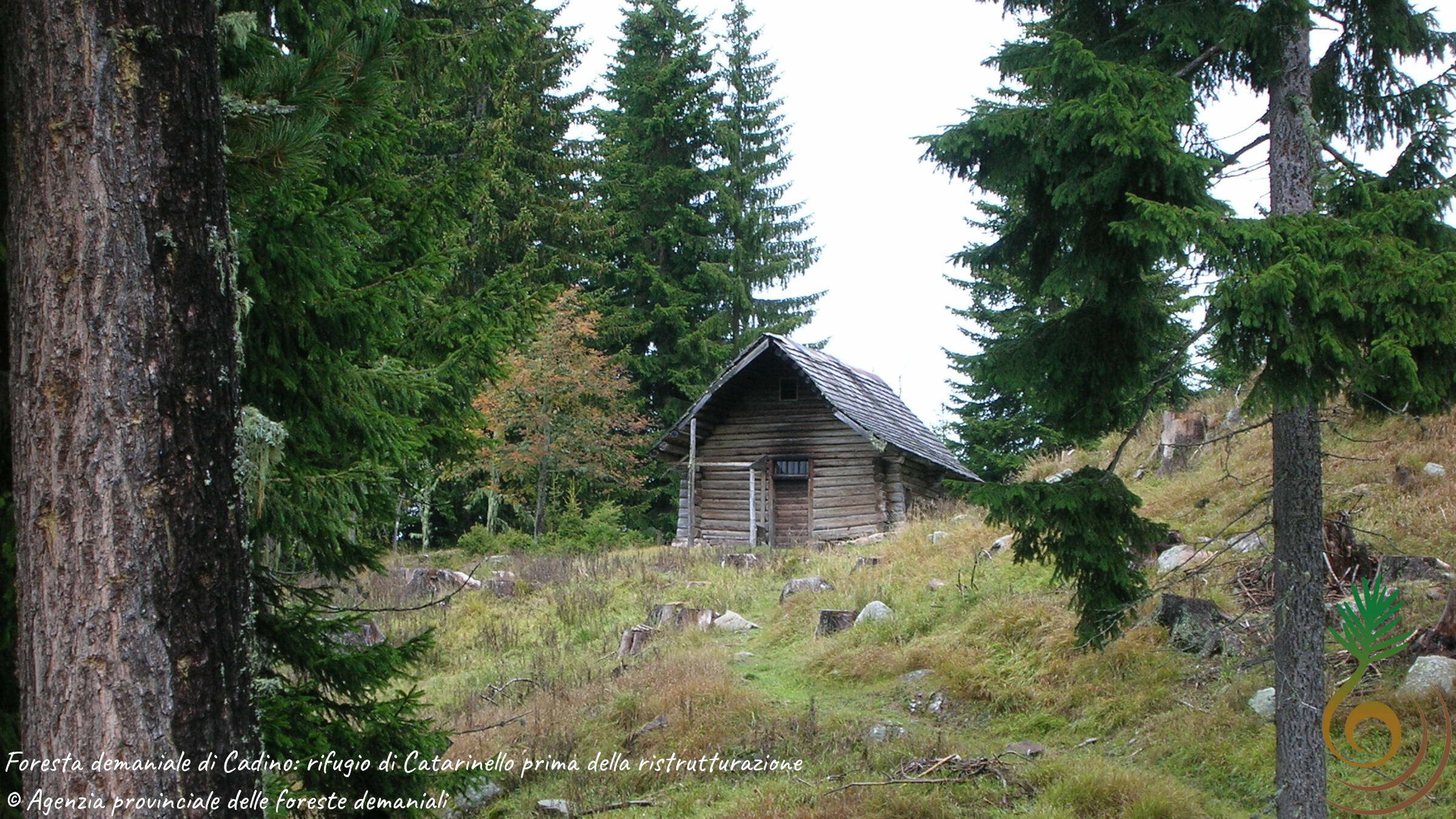
The Cadino Forest extends between 950 and 2412 metres above sea level in the valley of alluvial origin that runs from Molina di Fiemme into the heart of the Lagorai chain to the Manghen Pass. The vast woodlands suffered enormous damage from the historic 1966 flood and the 2018 Vaia storm, as well as bark beetle swarms.
The wooded Cadino Valley has important historical presences in addition to the provincial state: the Magnifica Comunità di Fiemme, the Regola Feudale di Rucadin, the municipalities of Castello Molina and Fornace, and Baron Longo of Egna.
Forest planning has a very long tradition in the State Forests, dating back to 1874, the year in which the first known forest management plan was drawn up for the Cadino forest.
Spruce is the most widespread conifer, accompanied by silver fir below and larch and stone pine above, which at times become almost exclusive. Broad-leaved trees are in the minority, but the presence of beech, here at its northern limit, and maple is significant, while preparatory species such as birch, rowan and green alder colonise the wide fractures. The Vaia storm disrupted this reality and in the following years the landscape became considerably less wooded; a robust reforestation campaign using naturalistic silviculture criteria was underway.
A curious note is the presence of small nuclei of trees foreign to the alpine vegetation introduced on an experimental basis at the beginning of the 1900s. These include the Colorado fir and the Douglas fir, a species planted in 1910 and which has achieved surprising acclimatisation results at Cadino, resisting the Vaia gusts and the subsequent bark beetle swarming.
The Cadino Forest has historically gravitated to important and consistent faunal populations, the subject of continuous observations and censuses. Among the Tetraonidae we find the capercaillie and the black grouse, the ptarmigan, the black grouse and the Alpine rock partridge. Among the ungulates are the red deer and chamois next to the roe deer, which dominate the lower altitudes. Golden eagles, kestrels and buzzards often appear in the skies over Val Cadino. Numerous, nocturnal, strigiformes. In the light of recent years, the situation for plants and animals is dynamic and constantly changing.
History
The historical events concerning the Cadino State Forest are significant and particular: after having been the property of the Vicinia of Valfloriana, it was acquired by the Counts of Tyrol and from 1027 by the Lordship of Enn-Caldiff. It was later owned by the Austro-Hungarian State Property Office, then, with the annexation of Trentino to the Kingdom of Italy, the Forest passed to the State Forest Property Office, then to the Trentino Alto Adige Region and finally, by provision of the Special Statute of Autonomy, to the Autonomous Province of Trento.
In the Cadino Forest informed
Access
The Forest can be reached via Provincial Road 31, which from Molina di Fiemme climbs to the Manghen Pass (2,047 m.) The pass goes up the Calamento Valley and connects Borgo Valsugana to Molina di Fiemme, crossing the entire Cadino Valley. Provincial Road 31 has narrow, impervious sections and is closed to traffic from October to April/May due to the numerous avalanches that affect much of the road.
The specific accesses to the various sections of the forest are provided by a network of forest roads that branch off from the valley floor near the forest station in Canton.
The management of the forest is entrusted to the Provincial Agency for State Forests, Technical and Management Sector in Cavalese (TN), which through the "State Forestry Station of Paneveggio and Cadino" monitors and enhances the forest and the many activities that affect it.
E-mail references: staz.demanialepaneveggiocadino@provincia.tn.it